Cardio exercise for gluteal tendinopathy – How to adapt swimming, cycling, and other activities to help recovery

Updated: Aug 25
It can be tricky to find effective ways to maintain your fitness while recovering from gluteal tendinopathy. In this article, we've ranked activities from the ones least likely to flare you up to the most problematic and explained how you can adapt them.
But every case is different, so we'll start by explaining which aspects of exercise might cause trouble and how you can avoid major flare-ups when testing activities.
Remember, if you need help with an injury, you're welcome to consult one of our physios online via video call.

The terms tendinitis, tendonitis, tendinosis, and tendinopathy mean the same thing for all practical purposes, and we use these interchangeably in our articles. Read more (opens in new window).
In this article:
We've also made a video about this:
How exercise affects gluteal tendinopathy
There are three aspects of movement or exercise that might irritate the gluteal tendons when they are injured. How much these affect someone's pain varies between people, so you don't necessarily have to steer clear of them – just keep an eye on things and observe how, or whether, they affect your pain:
How hard the tendons have to work: Any activity that involves you supporting all your weight on one leg works the gluteal tendons harder – and if you add speed to the movement (e.g. running, jumping, or speed walking), the force through the tendons increases.
Activities that stretch the glutes, pulling the tendons closer to and compressing them against the hip bone – e.g. any move involving deep hip flexion (bringing your knees towards your stomach) or that crosses your knees in towards or over the midline.
Simply doing too intense a session (too long, too high a resistance, too fast, etc.) for what the tendon can cope with at this point. Had you done an easier session that matched its current tolerance, things would likely have been fine.
You can read more about how and why these elements might cause trouble in this article where we explain what causes gluteal tendinopathy.
How to test various types of exercise
When you have gluteal tendinopathy, your tendons lose some of their strength and become very easy to irritate. The aim of this testing process is to help you figure out the lowest baseline of an activity you can currently do without experiencing a significant flare-up in symptoms.
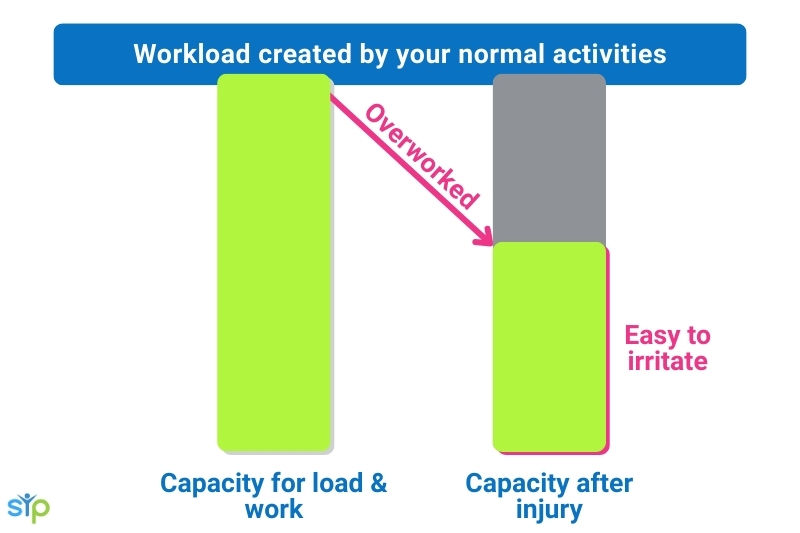
Flare-ups force us to pause our rehab until things settle, and they can be very demotivating, so limiting them is useful.
Once you know your baseline, you can gradually increase the intensity by adjusting things like duration, resistance, and terrain until you hit your current upper limit. Training at this level will help your tendons to recover, increase their tolerance, and slowly regain their full strength.
Here's a method that we've found works well for testing activities:
Test a very short, easy session – no more than 10 minutes if you have no idea whether it will work. That way, if it does flare up, it usually isn't too bad and settles down quickly.
Check how you feel during the session – if you're aware of only slight discomfort (no more than 3 out of 10), and it doesn't increase above that, it's a good sign.
Also check how your symptoms respond during the 24-hour period after the activity – if your pain increases significantly and stays elevated for more than 24 hours, that activity might have to be adapted or left for later in your rehab.
💡 It is normal and expected to be a bit more aware of your injury for up to 24 hours after an activity. What matters is how much the discomfort increases compared to normal, and how long that increased discomfort lasts.
Increased pain does not mean you're making your injury worse, but if it's regularly triggered at a high level, it can sensitise the pain system, which then prevents it from calming down (read more about that here).
Swimming with gluteal tendinopathy
Swimming is a great choice, because you can adapt it in so many ways. If your gluteal tendons are very irritated and don't tolerate even light kicking, you can gently squeeze a float between your thighs and swim using your arms only.
Freestyle kicking (straight legs) is usually better tolerated than the froggy leg action of breaststroke. If breaststroke is your preferred stroke, just take it easy on the leg action and don't force the full range of motion.
Kicking off the wall can cause trouble in some cases, so it might be worth adding that in only once you're confident your tendons are happy with the swimming action.


Cycling options for gluteal tendinopathy
In theory, cycling should be good for gluteal tendinopathy since it's relatively low impact, but the sitting position and repetitive motion can irritate some cases.
It might help to experiment with the type of bike you use – being bent forward in a racing position with your knees closer to the midline is often more aggravating. Swapping your road bike for a more upright mountain bike or hybrid might help.
If you're going to the gym, it's also worth testing a recumbent bike. Start with a medium resistance that lets your legs feel in control – you shouldn't really feel tired by the end of your first test session.

The cross-trainer or elliptical machine
The elliptical machine is often better tolerated than walking since the machine provides some of the stability – you're never having to take all your weight on one leg. Keep the resistance low to start with.

Walking
Walking might have to be quite limited during the early stages of recovery. That said, it's often the most accessible activity, and building up your walking tolerance can form an important part of your rehab.
We've written a detailed article where we walk you through 😉 how to best incorporate walking into your gluteal tendinopathy recovery.
Running
Running is a high-impact activity, and most runners will have to adjust their training to allow their tendons to recover. Some will need to temporarily switch to other forms of exercise, but others might be able to continue as long as they find a formula that their tendons are happy to tolerate.
You can find a detailed discussion in this article on running with gluteal tendinopathy: how to adapt your training, aspects of running form you might need to adjust, and how to judge whether you're pitching things at the right intensity.

Activities that will likely flare your pain up
There are always exceptions, but in general the following types of exercise tend to flare up gluteal tendinopathy pain:
rowing machine
stepper or step machine
any jumping or hopping, including skipping rope.
This doesn't mean you should avoid them forever – it's just best to leave them for the later stages of your rehab.
How we can help
Need help with an injury? You’re welcome to consult one of the physio team at SIP via video call for an assessment of your injury and a tailored treatment plan.

We're all UK Chartered Physiotherapists with Master’s Degrees related to Sports & Exercise Medicine or at least 10 years' experience in the field. But at Sports Injury Physio we don't just value qualifications; all of us also have a wealth of experience working with athletes across a broad variety of sports, ranging from recreationally active people to professional athletes. You can meet the team here.


About the author
Maryke Louw is a chartered physiotherapist with more than 20 years' experience and a Master’s Degree in Sports Injury Management. Follow her on LinkedIn and ResearchGate.