Running with gluteal tendinopathy – How to tailor your runs to allow recovery

Updated: Aug 19
If you've been diagnosed with gluteal tendinopathy and you're a runner, one of the first questions you're likely to ask is whether you need to stop running altogether. The good news is that many runners don't have to – but you will almost certainly need to make some adjustments.
This article explains how to modify your running to keep moving while giving your gluteal tendons the chance to recover.
Remember, if you need help with an injury, you're welcome to consult one of our physios via video call.

The terms tendinitis, tendonitis, tendinosis, and tendinopathy mean the same thing for all practical purposes, and we use these interchangeably in our articles. Read more (opens in new window).
In this article:
We've also made a video about this:
Gluteal tendinopathy quick overview
We've previously discussed in detail what gluteal tendinopathy is and how to diagnose it, but here's a quick overview:
It's an overuse injury affecting the tendons that attach the glute muscles (most commonly gluteus medius and minimus) to the outer, knobbly part of the hip bone (greater trochanter of the femur).

In runners, it's often caused by repeatedly overworking the glutes without enough recovery time.
Menopause can increase the risk of developing gluteal tendinopathy because the drop in oestrogen levels makes it harder for tendons to recover after exercise.
It usually affects only a small part of the tendon(s), which may lose some strength and become easier to irritate.
In some cases, the tendons don't actually lose strength – they simply become very sensitive and irritated.
Recovery starts by giving the tendon time to rest and calm down, then gradually rebuilding its strength (if needed) through a graded rehab plan – which might still include some running.
Movements that involve deep hip flexion (bending the hip forward) or crossing the leg over the midline of the body often make the pain worse, because they cause the injured glute tendons to pull tighter over and press against the outer hip bone – a bit like prodding a bruise repeatedly makes it hurt more.
Here is our full article on how to treat gluteal tendinopathy.
Can I run with gluteal tendinopathy?
In our experience, it's mostly runners with relatively mild cases of gluteal tendinopathy who can continue running throughout their recovery – and it will depend on whether you can find a way to adapt your running (see below) so that it doesn't aggravate your injury.
Once the gluteal tendons are injured, they often don't have the strength or endurance to cope with your usual training loads. We talk about a tendon's capacity to tolerate work. If you ignore the pain and keep running at a level that irritates them, your symptoms will usually get worse, their capacity will drop further, and you might eventually be forced to stop running altogether.
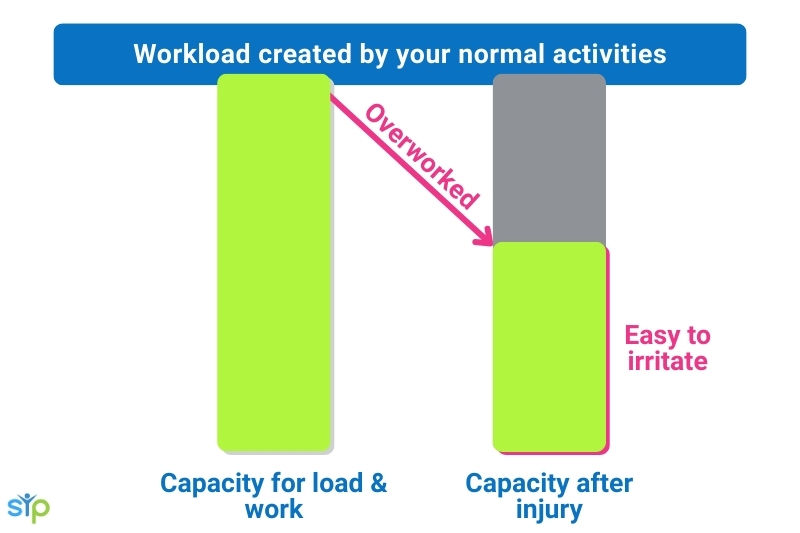
To help your injury recover, you need to scale back your training to match your tendons' current capacity.
💡 But it's not just about your running – you can sometimes "steal" capacity from other activities (by reducing things that aren't essential) and use it for running instead.
To understand this better, it can be useful to think of your tendons' current capacity as a bucket of water – and that water has to be spread across the whole week. If you use it all up today, there's nothing left for the days that follow. But your bucket does refill as you allow the tendons to recover properly after harder activities.
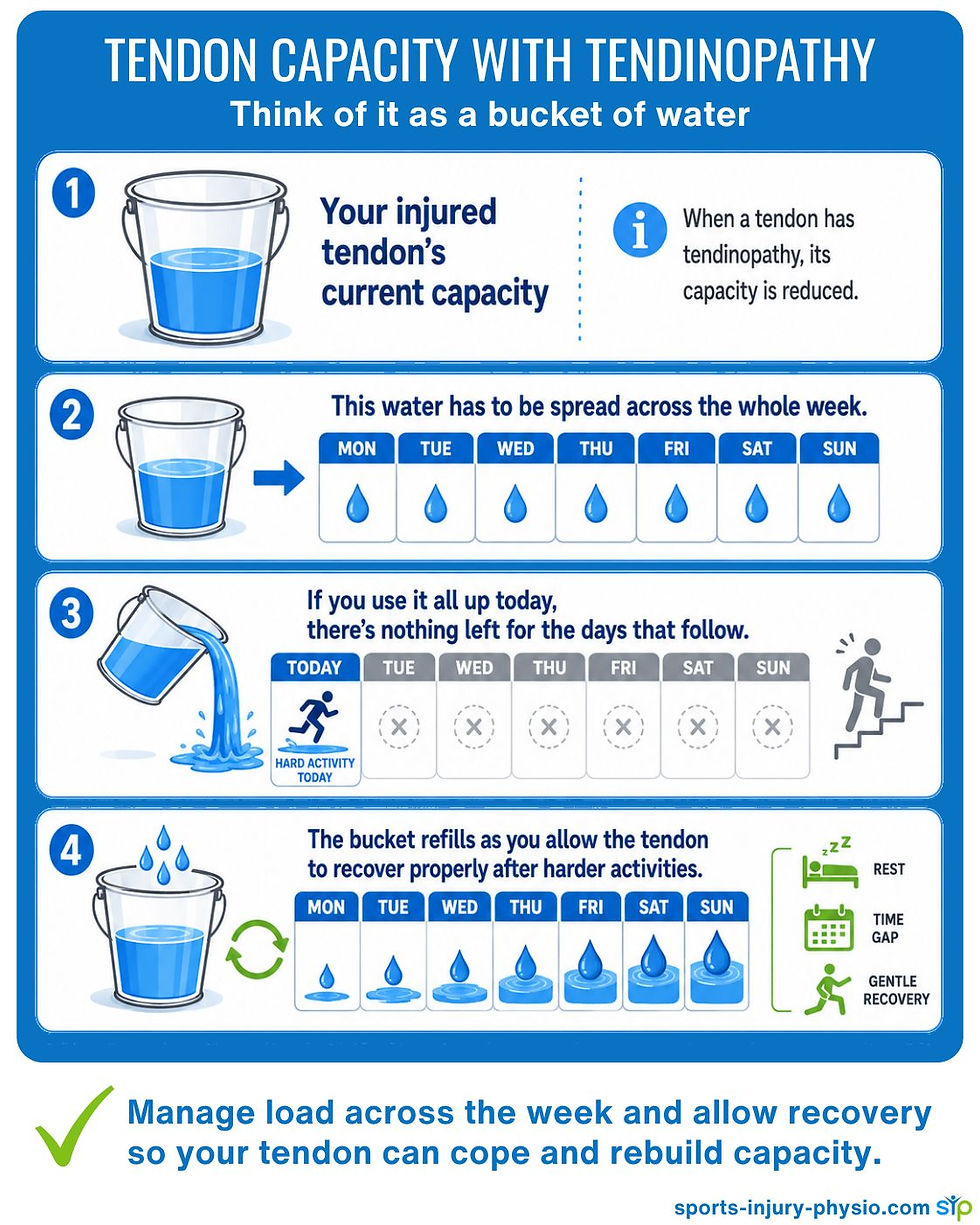
So ideally, we never want the water level to drop too far – the aim is to spread the load through the week so that your tendons have time to recover between sessions.
This is why, when we assess our patients' injuries, we want to know about all the activities they do across a day and week, not just their running. This allows us to structure rehab, running, and other activities into high-load and low-load days – using less of the tendon's capacity on some days so they can push a little harder on others.
How much glute pain is OK when I run?
The challenge with tendons is that they don't always tell you in the moment when they're unhappy – they tend to have a delayed reaction. It might feel absolutely fine while you're running, only for your symptoms to flare up several hours later or even the next morning.
💡 So, we have to consider both the delayed response over 24 hours and the overall trend across several weeks.
A helpful rule of thumb when recovering from gluteal tendinopathy is that running is generally fine to continue as long as:
you don't feel much discomfort during the run – it's OK to be aware of the area, but it shouldn't really be painful,
you don't notice any significant increase in discomfort in the 24 hours afterwards (especially the next day), and
any increase in discomfort settles back down fairly quickly.
If your symptoms flare up noticeably – particularly the day after a session – take that as a signal to ease back for your next run.
It's also worth comparing how you feel this week with last week. Are things staying stable or gradually improving? If so, you're likely on the right track.

🤷♂️ But how do you define a "significant" increase in discomfort?
This is where it gets a little nuanced. You might have heard physios quote a number – "up to 3 out of 10 pain is fine" – and there's some truth to that. Research does support training through mild discomfort, provided you don't consistently push beyond it.
The problem is that pain means different things to different people. Runners – especially those with marathon or ultra-marathon experience – often have a high pain tolerance, and what feels like a 3 to one person might be an 8 to another.
In practice, we've found that giving runners a pain score to aim for often backfires, because they simply don't register it as pain at all and keep pushing too hard. The result is that symptoms never get a chance to settle.
So instead of a number, we tend to say that you're training at the right level if you feel reasonably comfortable afterwards – close to how you'd feel if you hadn't run – and you don't need to modify how you move (your walking, for instance) because of it. It also shouldn't be occupying your mind or constantly drawing your attention.
But this method doesn't always work perfectly – if you've been keeping within these low-discomfort limits but things just don't seem to be improving, it can sometimes help to take a short break – a week or two of reduced activity – before gradually easing back into running.
👉 It's also worth remembering that a flare-up in pain doesn't automatically mean your injury has worsened. Pain levels don't reliably reflect the severity of an injury (which is why we all experience it so differently), but persistently irritating the tendon can eventually lead to pain that really starts to interfere with your training and daily life. We explain how the pain system works in this article.
If you find that running is out of the question (for now), have a look at some other cardio activities with gluteal tendinopathy you could consider in the meantime.
How to adapt your training for gluteal tendinopathy
Any adjustment that reduces the demand on the gluteal tendons during running – or improves recovery afterwards – can help. Things to experiment with include:
Running distance – shorter runs are generally better tolerated than long runs.
Speed – the faster you run, the harder your glutes work.
Terrain – hill running (up and down) and running on a camber increases the load on the glutes.
Frequency – can you swap some run days for cross-training? This reduces the overall load on the gluteal tendons across the week.
Recovery days – adding more recovery days might allow you to complete your key sessions with only minor adjustments to your running.
Total time on feet – your glutes work whenever you're upright, so reducing the amount of standing and walking you do on running or recovery days may mean your tendons can tolerate a little more running.
Running form – there are specific adjustments that can help, which we discuss further down.


Pre-run test – Do you need more recovery?
So, you've figured out what amount of running your gluteal tendons are currently happy to deal with, but how do you know that they have recovered enough from your previous training session to run today?
If your legs are still tired from your previous workout, then it's quite obvious that you need more recovery. However, if your legs feel fine, adding in a test specifically for the glute tendons can be useful.
You can use any movement that creates a strong isometric contraction of the gluteal tendons as your test. The aim is to see if your tendon feels like it normally does when you've not done any hard workouts, or whether it's more sensitive than normal, which would indicate that giving it a bit more recovery time would be a good idea.
The movement has to fit your specific case – it must be challenging, but something your tendon is usually happy to cope with, and you must have tried it before, so you know what your baseline or normal pain score is when you do it.
Examples of movements that could work:
pushing your leg out to the side against a wall
pushing your leg out to the side against a resistance band and holding it
doing a side plank on your knees, or a full side plank if that matches your current capacity.


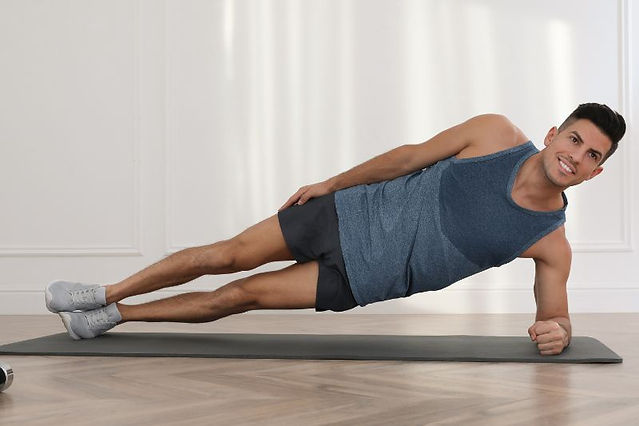
Step 1: Pick your test movement and do it on days where you know your tendon should be recovered – observe your baseline symptoms.
Step 2: Repeat this test before your runs and compare what you feel with your baseline.
If your tendon is significantly more tender or uncomfortable, or you fatigue significantly more than you would expect, it's a sign that perhaps it hasn't fully recovered from the previous workout or activity. In which case you have to decide if you:
postpone your run session by one day to allow full recovery
do a very easy run session
or ignore it and do your planned session regardless – this is not a great idea in my opinion.
Deciding to postpone a training session can be a bit of a mental challenge, but I've found this the best option for myself when I've been injured. On the occasions where I've opted to do the session and just keep it super easy, I didn't really enjoy it, because I was nervous that I was making a mistake and also frustrated that it didn't feel like proper training.
Running form adjustments
Not all runners with gluteal tendinopathy need to change their running style – it's only worth considering if you recognise one of the following patterns in yourself.
Running with a narrow gait
This is when you place your feet close to your midline as you run – almost as if you're running along a tightrope. If you frequently clip your ankles, this could be why.

How to fix it
Start by simply noticing where your feet land in relation to the midline of your body, then try widening the distance by a few centimetres. It doesn't need to be a big correction.
This is something I've had to work on myself, and I found it helpful to focus on not kicking my own ankles. I also used the thick yellow lines on quiet roads as a guide, aiming to place my feet about 3–5 cm out to either side. That said, my narrow gait improved more noticeably once I started working on reducing how much my legs turned inward.
If your legs turn in excessively
The easiest way to spot this is to watch what your knees do as you run. It's normal for the knee to move inward slightly as your weight shifts over the supporting leg – so the aim is not to eliminate this entirely, just to reduce it.

It can simply be a habit, but it can also be a sign of weak gluteal muscles. I tend to drift into this pattern when I'm tired – towards the end of a long run, for instance – which is a good reminder that glute endurance is something worth working on.
How to fix it
Improving your cadence (step rate) or reducing overstride (see below) can help automatically. But habits are hard to break, so it's likely you'll also need to actively think about your form during runs. One approach used in research is to focus on keeping your knees pointing in a generally forward direction.
Strengthening your glutes can also make a real difference – not only does it improve strength and endurance, but practising good movement patterns during exercises like squats helps your brain learn how to control your legs more effectively when you run.
👉 Working on glute strength forms a key part of the treatment of gluteal tendinopathy in any case – you can find advice on gluteal tendinopathy exercises here.
If your pelvis drops excessively
It's normal for the pelvis to dip slightly as you lift and swing your leg through – but this drop shouldn't be excessive. A large pelvic drop is often linked to weak glute muscles, though it can sometimes just be a movement habit.

How to fix it
The approach is similar to what's described above – reducing overstride and strengthening the glutes are two of the most effective strategies.
If you overstride
You're overstriding if you consistently land with your heel well in front of your body. This creates a braking force that increases the impact your glutes (and the rest of your body) have to absorb.

Overstriding is the one factor that consistently comes up in research as increasing the risk of almost any running injury. It's also worth noting that addressing overstride tends to improve nearly all the other form issues mentioned above – so this is a good place to start.
How to fix it
Two cues that tend to work well are:
Lean your whole body slightly forward as you run – not by bending at the waist, but so that your chest is naturally just a few centimetres ahead of your feet.
Think about landing your feet a little closer to your body – heel contact is fine; it just shouldn't be so far out in front.
Avoid forcing yourself into midfoot or forefoot running if your natural preference is to heel strike. Heel striking isn't the problem – making too drastic a change to your gait is often unsustainable and can lead to other injuries.
💡 There's no such thing as a perfect running style, and trying to make big changes all at once rarely works. In my experience, improving these factors by just a small amount can make a meaningful difference.
It's best to practise any form changes through a run-walk programme. This gives your body time to adjust to the new movement pattern without placing too much strain on other areas.
👉 You can find more treatment and exercise advice for gluteal tendinopathy here.
How we can help
Need help with an injury? You’re welcome to consult one of the physio team at Sports Injury Physio via video call for an assessment of your injury and a tailored treatment plan.

We're all UK Chartered Physiotherapists with Master’s Degrees related to Sports & Exercise Medicine or at least 10 years' experience in the field. But at Sports Injury Physio we don't just value qualifications; all of us also have a wealth of experience working with athletes across a broad variety of sports, ranging from recreationally active people to professional athletes. You can meet the team here.


About the author
Maryke Louw is a chartered physiotherapist with more than 20 years' experience and a Master’s Degree in Sports Injury Management. Follow her on LinkedIn and ResearchGate.