
What is better for tendonitis – ice or heat?

Updated: Aug 20
Whether ice or heat is better for your tendon pain depends on whether there is inflammation. Sports physiotherapist Maryke Louw explains how you can tell whether this is the case and how to safely apply ice and heat so that it doesn't interfere with your recovery.
Remember, if you need help with an injury, you're welcome to consult one of our physios online via video call.

The terms tendinitis, tendonitis, tendinosis, and tendinopathy mean the same thing for all practical purposes, and we use these interchangeably in our articles. Read more (opens in new window).
In this article:
We've also made a video about this:
This article contains affiliate links. We might earn a small commission on sales at no extra cost to you.
When to use ice and when to use heat
Ice and heat can both help to reduce your tendon pain, as long as you use them during the correct stage of your tendonitis.
Why does the injury stage matter? 🤷♂️
Ice can help inflammation to settle down, while heat might increase it and cause excessive inflammation, which could aggravate your symptoms.
Research has shown that inflammation can be present in the tendon during the early stages of recovery (shortly after you develop your tendon pain for the first time) or if you experience a sudden flare-up of symptoms in an ongoing tendon injury.
In some cases, tendonitis caused by inflammatory conditions like gout – or as a side effect of certain antibiotics – can also involve a stronger inflammatory reaction than usual.
However, when researchers looked at ongoing tendon injuries (where tendon pain has been present for more than three months), they didn't find any signs of inflammation.

This is also why the term tendonitis or tendinitis is more commonly used for tendon injuries that are relatively new (the "-itis" ending indicates inflammation in medical terms) and the term tendinopathy is more commonly used for ongoing cases (the "-opathy" ending refers to injuries where the problem is a failed healing response).
❄️ So, our advice is to use ice:
If your tendon pain has been around for less than three months,
You've experienced a sudden severe flare-up in symptoms,
Your tendonitis is linked to an inflammatory condition (like rheumatoid arthritis or gout) or antibiotics (like fluoroquinolones),
Or the area is showing signs of active inflammation (is red, swollen, hot to touch or throbs).
🔥 You can use heat:
If your injury has been around for more than three months, you can usually use either ice or heat – whichever you find most effective – to help your symptoms to calm down.
You can use heat on your muscles, avoiding the injured tendon, at any stage of recovery.
Does ice or heat speed up healing?
Not directly – and it can be counterproductive if you overuse it.
Cooling or heating the affected tendon and muscles can help your pain settle down, but it does not change anything inside the tendon that speeds up healing. But lower pain levels can help you to move and sleep better, which can contribute indirectly to better recovery.
👍 So, if you're struggling to get the pain to settle, it can be a useful addition to your treatment.
You can find more information about the best research-based treatments for different types of tendonitis and tendinopathy here.
I mentioned inflammation earlier, and people often think if you can reduce inflammation, it must lead to quicker recovery. However, inflammation is actually thought to be important for the healing process when you have tendonitis and should not be suppressed unnecessarily. It is only when inflammation becomes excessive that it causes trouble (in which case ice can help).
💡 This is why we don't prescribe routine icing to all our patients – not everyone needs it. But in cases where it is needed (if there are clear signs of excessive inflammation or just very high levels of pain), it can be extremely useful.
Also, please don't worry that icing your tendonitis will stop it from healing – I often see people spread the message on social media that ice is bad for injuries, in an attempt to create controversy. If you apply ice in a sensible way, like we share in this article, the effects are not strong enough to suppress your useful inflammation – you'll get the benefits without causing harm.
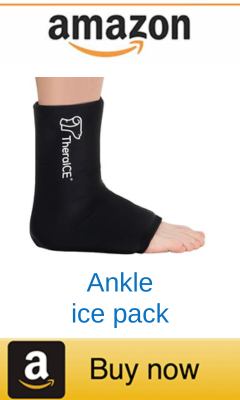
The products below are all multipurpose packs and can be used for either icing a tendon injury or to apply heat to it.



How to use ice for tendonitis
You can safely use ice during any stage of tendonitis recovery.
We usually advise our patients to apply ice treatment whenever they experience a painful flare-up or if their pain is excessive. It's also useful if there are clear signs that there might be excessive inflammation in the area (redness, swelling, or if the area is warm to the touch).
How to apply ice
Wrap the ice (or whatever source of cold you're using) in a wet towel – this protects your skin against ice burns while still allowing the cold to be transmitted effectively.
Apply the ice for 10 minutes only – if it's an area with little muscle or fat (like the wrist or ankle), 7 minutes might be more appropriate.
Then remove the ice for 10 minutes – research has shown that this allows your skin to warm up (preventing ice burns) while the tissue just below the skin remains cool.
Then reapply the ice for 10 minutes.
In some cases, we might advise that our patients repeat this process 2 to 3 times a day, leaving at least 2 hours between sessions.
👎 Don't use ice
if you have a condition that affects your blood vessels or circulation
if you do not have normal sensation (can't feel cold or pain) in that area.


How to use heat for tendonitis
Heat is great at relaxing muscles and reducing pain. If someone is struggling to get their pain under control and their tendonitis has been going on for more than three months, we often advise them to experiment with heat and ice to see which one works best for helping their discomfort settle down.
For example, some of our patients with proximal hamstring tendinopathy find that sitting on a heat pad can help to reduce their discomfort while driving.
It's worth remembering that our cells and tissues function best when they are at a specific temperature. So, similar to using ice, it's not a good idea to heat the area excessively by using either very hot packs or simply applying it for too long.
💡 There are no established guidelines for what is seen as a safe application of heat. Applying moderate heat for around 30 minutes seems to be a good option for most people.
👎 Please don't apply heat to an area that has open wounds, active bleeding, or is showing signs of inflammation (is red, warm to the touch, swollen, or throbbing) – it will make things worse.
It's also best to avoid using heat if you have circulatory issues or reduced sensation in that area, since you might not feel it if you burn yourself. Also, be careful if you get lightheaded or faint easily.
How we can help
Need help with an injury? You’re welcome to consult one of the team at SIP online via video call for an assessment of your injury and a tailored treatment plan.

We're all UK Chartered Physiotherapists with Master’s Degrees related to Sports & Exercise Medicine or at least 10 years' experience in the field. But at Sports Injury Physio we don't just value qualifications; all of us also have a wealth of experience working with athletes across a broad variety of sports, ranging from recreationally active people to professional athletes. You can meet the team here.


About the Author
Maryke Louw is a chartered physiotherapist with more than 20 years' experience and a Master’s Degree in Sports Injury Management. Follow her on LinkedIn and ResearchGate.


